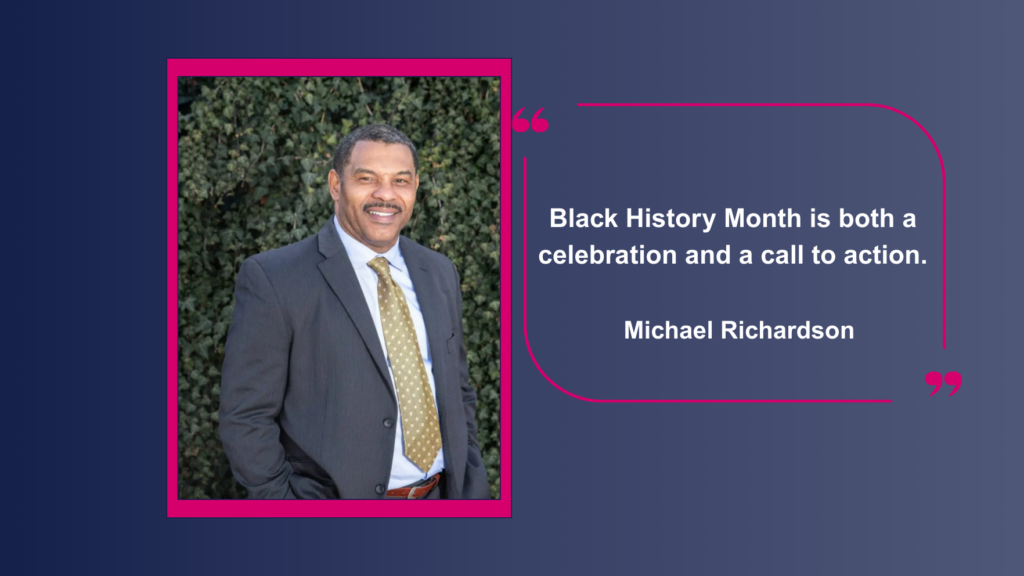
At Spinal Cord Injury Ontario (SCIO), we believe representation, lived experience, and community leadership matter. During Black History Month, our CEO, Michael Richardson, reflects on his leadership journey, the importance of representation, and how SCIO is working to advance equity in the disability sector.
A Leadership Journey Rooted in Community
I’ve been working in social services for over 20 years, primarily in the child welfare sector. My journey into this work began long before my professional career it started in my childhood.
I grew up in low-income housing in Mississippi, raised by my grandparents in a household with a strained family support system. As a person of colour, I saw firsthand the systemic challenges many families face. I consider myself lucky. My grandparents were deeply involved in our community, and they made sure I was surrounded by people who cared about my well-being and success.
They taught me the meaning of servant leadership. I attended pancake breakfasts, soup kitchens, community meetings, and local events alongside them. I learned that leadership isn’t about position it’s about service, advocacy, and standing beside those who are most vulnerable.
After retiring from professional sports, I felt called to work in social services because I saw parallels between my upbringing and the children, youth, and families served by the child welfare system. Throughout my career whether mentoring through Big Brothers, reading to elementary students during university, organizing celebrity charity softball games in the U.S., or fundraising and building resources in Winnipeg community has always been at the center of my work.
As my career evolved, and as my wife experienced a spinal cord injury, my connection to disability deepened in a profoundly personal way. I truly believe things happen for a reason. My journey to SCIO feels purposeful both professionally and personally.
Representation in Leadership Matters
It is an honour to serve as CEO of Spinal Cord Injury Ontario. I deeply respect the work that predates me, and I am committed to leading with excellence, integrity, and accountability.
Representation matters.
Being a Black executive carries additional responsibility. I recognize that someone who looks like me may see what is possible through my leadership. If my journey inspires even one person not to lose hope in pursuing their goals, that matters.
At the same time, representation alone is not enough. My credibility has always been built on performance. My role is to ensure SCIO remains financially strong, well-governed, team-driven, and demonstrably impactful for the community we serve. Symbolism must be matched with results.
Black History Month, Health Equity, and Disability
Black History Month is about celebrating those who came before us and acknowledging their contributions — not only to the Black community, but to society as a whole. It also reminds me of my responsibility to contribute meaningfully and to challenge structural inequities.
When we talk about health equity, we must include disability.
We cannot treat them as separate issues. People with disabilities often face the same systemic barriers that drive health inequities — poverty, racism, inaccessible systems while also navigating disability-specific challenges.
If we talk about health equity but don’t include disability, we leave people behind.
As a Black leader in the disability sector, I am acutely aware that health outcomes, access to care, and community supports are shaped by socioeconomic conditions. At SCIO, that awareness must translate into action through culturally responsive programming, trauma-informed approaches, and a commitment to closing gaps in access and opportunity.
Building Inclusive, Culturally Responsive Support Systems
Organizations like SCIO must continuously examine how well we reflect and serve the diverse communities across Ontario.
That begins with listening especially to individuals with lived experience. It requires building strong partnerships within diverse communities, ensuring our services are accessible and culturally responsive, and holding ourselves accountable through measurable outcomes.
Inclusive care is not a one-time initiative. It is ongoing work that must be embedded in leadership, governance, staffing, and service delivery. At SCIO, we are committed to learning, evolving, and ensuring that our programs truly meet people where they are.
A Message to Black Individuals Living with Disabilities
To Black individuals living with disabilities: you are seen and heard at SCIO. Your experiences matter. Your voice matters.
I understand that many have navigated systems that have not always been designed with you in mind. I respect your resilience, your courage, and your perseverance. You deserve equitable access to care, culturally responsive support, and communities that recognize your full humanity.
To those supporting Black individuals with disabilities: thank you. Black History Month should challenge all of us to think critically about the systems we operate within.
Ask yourselves:
- What policies are not working?
- What assumptions need to be confronted?
- How can I help build systems that truly embrace lived experience?
Progress requires collective responsibility.
Advancing Equity Without Placing the Burden on Those Impacted
From a leadership perspective, advancing equity must be driven by those not directly impacted by inequities. Asking Black employees or any equity-deserving group to carry the emotional weight of education and systems change is unfair and unsustainable.
In previous roles, I have ensured that equity work was embedded at the leadership level by establishing voluntary DEI committees; embedding equity performance metrics into leadership accountability; bringing in external facilitators to educate teams; hosting structured learning sessions; and creating psychologically safe environments where questions and dialogue are encouraged.
At SCIO, equity must be part of how we lead not an additional burden placed on those most affected.
Moving Forward with Purpose
Black History Month is both a celebration and a call to action. It reminds us of the resilience that brought us here and the responsibility we carry to build systems that are more inclusive, equitable, and just. At Spinal Cord Injury Ontario, that work continues grounded in lived experience, strengthened by community, and guided by servant leadership.