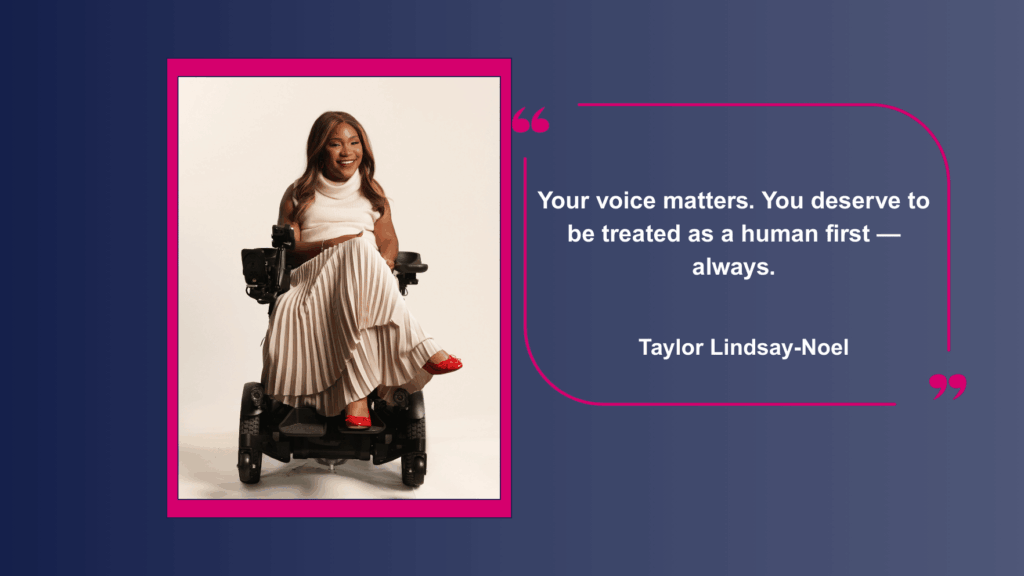
During Black History Month, Spinal Cord Injury Ontario is proud to spotlight the voices and lived experiences of Black individuals within our community. Representation matters not only in media and leadership, but in health care, advocacy, and support systems that shape people’s lives after injury.
For Taylor Lindsay-Noel, sustaining a spinal cord injury at 14 marked a significant turning point in her life. Today, at 32, she is an entrepreneur, accessibility advocate, and founder of Access by Tay, using her platform to amplify conversations around disability, equity, and inclusion.
Her journey is a powerful reminder that community, self-advocacy, and dignity in care are not luxuries; they are essential.
A Life Reimagined at 14
Taylor was just 14 years old when a gymnastics accident resulted in a spinal cord injury. The transition was sudden and required significant adjustment. She identifies as a quadriplegic and has described the adjustment as a steep learning curve.
But what grounded her then, and continues to ground her now, is community.
“What helped me stay grounded then and now has always been community especially my family and close friends,” Taylor shares. “Their support gave me the confidence to keep moving forward, even when the future felt uncertain.”
That foundation of support helped shape the path forward. Since her injury, Taylor has returned to university, earned a degree in Radio and Television Arts, launched her luxury organic tea company Cup of Té and built a respected career as an accessibility and disability advocate through her platform, Access by Tay.
“None of that would have been possible without the people who believed in me before I fully believed in myself,” she says.
Her story reflects what is possible when community, confidence, and determination come together.
The Role of Advocacy in Health Care
Recovery and adjustment after spinal cord injury require more than medical intervention. For Taylor, one of the most impactful lessons was learning how to advocate for herself within the health-care system.
“The biggest difference for me came from having a strong combination of medical care and personal advocacy,” she explains. “While I was supported by health-care professionals, what truly shaped my experience was learning how to ask questions, speak up, and be involved in decisions about my own care.”
Having providers who were willing to listen made a meaningful difference. So did having family members who could advocate on her behalf when she needed additional support.
Her experience reflects something many individuals living with spinal cord injury come to understand: informed self-advocacy can significantly influence outcomes, confidence, and long-term well-being.
At Spinal Cord Injury Ontario, we see firsthand how empowering individuals with knowledge, peer support, and resources can help them navigate complex systems with greater confidence.
Navigating Health Care as a Black Woman in Canada
Taylor’s experience also carries another important dimension navigating health care as a Black woman in Canada.
“As a Black woman in Canada, I do believe there can still be bias within health-care spaces,” she shares. “Because of that, I learned early on how important it was to advocate fiercely for myself and to make sure my voice was heard.”
Bias in health care — whether conscious or unconscious can impact how concerns are received, how quickly issues are addressed, and how seriously patients are treated. For Taylor, having strong support made a significant difference.
“I was incredibly lucky to have my mom by my side through it all. She has always been my biggest champion, making sure I received the care I deserved and that my concerns were taken seriously.”
Her story highlights the importance of culturally responsive, equitable care and the role that family, community, and advocacy play in bridging gaps that should not exist.
Everyone deserves to feel safe, respected, and heard in spaces designed for healing.
Why Being Seen and Respected Matters
For Taylor, representation and dignity in health care are not abstract ideas they are deeply personal.
“You only get one body,” she says. “The quality of care you receive can be directly impacted by whether providers see you as a whole human being first, not just a diagnosis or a chart.”
When individuals feel respected, trust grows. And trust shapes outcomes.
“When people feel respected, they’re more likely to trust their care team, speak honestly about their needs, and advocate for themselves,” Taylor explains. “That sense of humanity and dignity can make all the difference in long-term outcomes.”
Being seen is not simply about visibility. It is about recognition of identity, culture, lived experience, and voice. It is about understanding that people are more than their injury — and more than their medical file.
In health care and community support spaces alike, that recognition can be transformative.
“Your Voice Matters”
As we reflect during Black History Month, Taylor’s message is clear and powerful.
“My message is simple: your voice matters. You deserve to be treated as a human first, always. No one should ever experience discrimination because of the colour of their skin, especially in spaces meant to support healing and care.”
Even in rooms where representation feels limited, she believes in the impact of speaking up — not only for oneself, but for those who come after.
“Even when we don’t see ourselves represented in every room, our voices still carry power. And when you’re in a position to speak up or create space for others, it can make a lasting difference.”
Her words resonate far beyond a single month. They speak to equity, dignity, and the collective responsibility to build inclusive systems of care.
Moving Forward Together
At Spinal Cord Injury Ontario, we are committed to fostering a community where every individual living with spinal cord injury feels supported, informed, and empowered. That includes advocating for equitable access to health care, promoting peer support, and ensuring diverse voices are reflected in the stories we tell and the services we provide.
Taylor Lindsay-Noel’s journey reminds us that advocacy begins with voice and voice begins with being heard.
This Black History Month, and every month, we celebrate the leadership, resilience, and contributions of Black individuals within the spinal cord injury community.
Because every person deserves to be seen.
Every person deserves respect.
And every voice matters.
About Taylor Lindsay-Noel
Taylor Lindsay-Noel is an accessibility advocate, entrepreneur, and founder of Access by Tay. She is also the founder of Cup of Té, a luxury organic tea company. Through her platforms, she advocates for disability visibility, inclusive design, and equitable access in health-care and community spaces.